
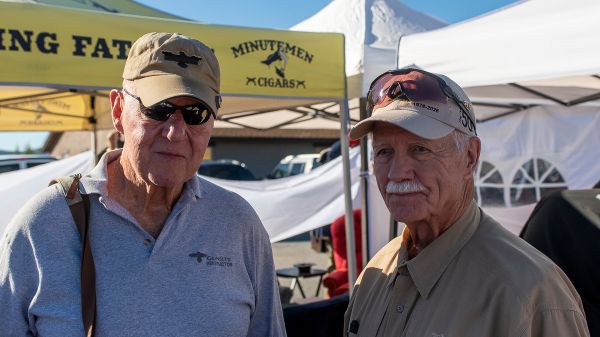
During last weekend’s 50th Anniversary Gunsite Alumni Shoot (GAS), I had the opportunity to sit down with longtime Gunsite instructors Ed Stock and Charlie McNeese. They have a combined 69 years of experience as instructors and played an integral role in shaping what Gunsite is today.
While I had certainly heard their names, I’d never had the pleasure of meeting them before this event. To better explain who these two gentlemen are, I asked Michael Bane to put their place in the pantheon of firearms instructors into perspective.
“We are truly in a Golden Age of firearms instruction. No matter where you live, there’s certainly no shortage of firearms instructors…even very good instructors. But there’s a level above “very good,” or even “Master.” There are instructors who helped shape the very DNA of what we know about the great American martial art, self defense with the handgun. Ed Stock and Charlie McNeese are two such instructors. First in law enforcement, then as an integral part of the legendary Gunsite, Ed and Charlie were key to taking Col. Jeff Cooper’s vision to the next level.”
I asked Ed and Charlie to reflect on Gunsite, its impact on training and instructor development, and how it has evolved over its first 50 years.
QA Outdoors
We're here at the Gunsite Alumni Shoot (GAS), celebrating Gunsite’s 50th anniversary. What, in your opinion, is the biggest impact Gunsite has had on firearms training, instructor development, and the defensive use of firearms?
Ed Stock
When Cooper first started teaching handguns in the Big Bear area, he produced what was called the leather slap, and a bunch of the old handgun competitors came in. One of them was Jack Weaver.
Jeff was an educator, a lecturer, and a bit of a scientist in the area of firearms. He was watching who was winning the matches, and Jack Weaver continued to come out on top. He had a particular technique that Cooper looked at, analyzed, creeded. Later, when he started teaching, he referred to this as the Weaver technique.
This is the technique Jeff brought into Gunsite. It was based on unrestricted competition—who won and who lost. That was the basis for the training at Gunsite, and the first classes were just pistol classes.
Jeff opened the school with the main purpose of teaching the armed citizen. Obviously, law enforcement got involved. Charlie and I are both former law enforcement, but Jeff wanted to teach everyone who wanted to learn the proper and safe use of the pistol. That's why he opened Gunsite, and it's expanded greatly ever since.
The teaching we do goes around the world. We have both had students from all over the world come here, and they continue to spread that technique and knowledge through classes for civilians, military, and law enforcement.
QA Outdoors
When it comes to training globally, and certainly here in the U.S., is it safe to say that Gunsite is the foundation of all firearms training, or close to it?
Charlie McNeese
I wouldn't say it's the foundation of all firearms training. A lot of people have tried to mimic what Gunsite does, but they want to put their own spin on the way they do things. Jeff was very, very strict about the way he wanted to teach the modern technique, which he developed with the Weaver stance—a fighting platform.
He also wanted you to perceive threats early enough that you could avoid getting involved in a gunfight or getting hurt, instead of walking with your head down or not paying attention.
Jeff really emphasized that if you have good gun-handling skills and you're safe, you have a better chance of surviving a deadly force confrontation. Either you don't have to get involved, or, if you do, you have a very good chance of surviving it.
QA Outdoors
What has been Gunsite's impact on instructor development in the broader training community in the U.S.? To what extent has the quality of Gunsite instructors influenced instructors elsewhere? Are other training companies sending their people here to learn how to become better instructors?
Charlie McNeese
We have a lot of law enforcement instructors come here. Departments send their instructors to learn how to teach the information Gunsite provides.
Ed and I were from the same department. When we started teaching the Gunsite method at our department, it made a drastic change in our officers. It gave them more confidence in their ability, more confidence in their weapon, and more confidence in their ability to reload and hit the target, more so than just grazing the skin and causing it to hit. They made a difference in protecting themselves for an innocent third party.
All these departments sent people here to learn. They couldn't believe we were teaching what we were. When those instructors went back to their departments, they sometimes had a little trouble teaching it. But once their departments learned what they had learned here, they adopted it, and they have done very well.
Ed Stock
We had two very famous LAPD SWAT officers come here to learn what Gunsite teaches in the way of the modern technique. They took it back to LAPD and tried to introduce it.
LAPD, like any other large department, is a bit of a bureaucracy. They had been teaching a certain way for years, and the idea of these two officers bringing in the modern technique was not welcomed.
Finally, there was enough impetus to allow them to teach one class using the modern technique, and the class set records for its shooting performance.
That's a credit to Gunsite and the modern technique, but it's also a credit to those two officers because they were absolutely outstanding. I had both officers in class, and they brought a lot to the table when they came here.
QA Outdoors
With so many law enforcement instructors having trained at Gunsite—and major departments like LAPD incorporating its methods—has it become easier over time to get other departments to adopt that approach to training their officers?
Charlie McNeese
A lot of times, when departments have budget cuts, the first thing they cut is firearms training, and maybe driver training. They may cut back to shooting only 50 rounds once a year.
Working with a handgun is a diminishing skill. If you don't do it enough, you lose the skill. You lose confidence in your ability and in your weapon, and that lessens your ability to make the right decisions.
You don't have time if you've only got 1.5 seconds to make a decision and hit a target that may be 21 feet away.
QA Outdoors
When you started more than three decades ago, could you have envisioned Gunsite becoming what it is today—arguably the gold standard for a firearms training facility and curriculum? Could you have imagined it celebrating 50 years, looking ahead to the next 50, and seeing record attendance year after year?
Ed Stock
Not at all.
Both of my brothers were also retired law enforcement. One of them heard about this school in northern Arizona called Gunsite and said, “Hey, are you interested in going?” I had read some of the articles that Cooper had written, and I said, “Yeah, that sounds interesting.” So he and I came up to take the 250 class at Gunsite.
Both of us had a number of years in law enforcement, and we were both firearms instructors. We thought we were really good at shooting. Then we came here and were humbled by how much we didn't know, particularly about the tactical use of the handgun.
Up until that time, everything we did was based on PPC shooting, which was just static competition target shooting. Here, they teach surviving a gunfight—a lethal encounter—and getting hits on target from many different ranges as rapidly as possible.
As far as envisioning what Gunsite would become when I first came here, four years after it started—no. I am amazed.
I've been retired from Gunsite for about nine years, and every time I come here, the facility has grown. The instructional staff has grown. This has turned into 10 times what it was when I came through here.
QA Outdoors
When you look at Gunsite today, do you feel a sense of pride knowing you both played a role in helping it become something you could never have imagined?
Charlie McNeese
I do. I wear shirts with the raven on them, and I've been all over the United States and run into people who recognize me.
I was at SeaWorld with my daughter, my wife, and my grandson. There was a group of four or five people, and one of them looked at my shirt and said, “Gunsite.” Then he looked at me and said, “Oh, I've seen you on YouTube. You're Charlie.” I said yes, and all my daughter wanted to say was, “Can we go now?”
It gives you pride to know that you may have been involved in saving somebody's life. A man told me his daughter was in college, and someone tried to break into her room. She got by the bed because Charlie told her, “Don't lose contact with him. Have your pistol ready.”
The 9-1-1 operator said, “Go lock yourself in the bathroom.” She said, “That's not what Charlie would tell me to do. I'm going to stay here, stay on the phone, and watch that window.”
When the dad called, he told me, “You're not going to believe what my daughter did. It made me so proud because what you taught her probably saved her life.”
That is what gives you pride—knowing you helped somebody defend themselves and save themselves, and today they're still alive.
Ed Stock
Gunsite gets calls with some regularity from prior students who have been in a lethal confrontation. I remember one call I got from a Yuma sheriff's deputy. I answered the phone at 2 o'clock in the morning, and he said, “Ed, it works. He's dead. I'm alive.”
Then you know you've done something right.
QA Outdoors
Is there anything else about Gunsite or your roles here that you think we should include?
Charlie McNeese
The way Gunsite works is that we've made small adjustments as things have changed and different types of weapons have come into use. We've made those adjustments, but we haven't completely changed the program Cooper designed.
We add a little bit here. Since we've all gone to semi-automatic weapons, we might change how we're doing reloads or positioning the magazines on our belts. Now we've got red dot Aimpoints, and we're still using iron sights.
That's a big change in the way things are done. But I learned a lot from Ed Stock, and it took Ed a lot of time to beat me to tell me, “You have got to go to Gunsite and be an instructor.”
I hand everything over to Ed because, when we did classes, I would have him come and participate and be the instructor to teach me more about Gunsite.
Coming to Gunsite changed my life. I was a Marine. I thought I knew all there was to know about operating weapons. The Marine Corps taught me a lot, but it didn't touch what Gunsite taught me.
Being able to teach other people—having the patience, ability, and knowledge to put them in a position where they have competence and safety on their side if they get into a confrontation—made a big difference to me. It gives me a lot of pride.
Ed Stock
In addition to teaching law enforcement, we've had entire classes of Marines. The Marine Corps sent over several classes full of active-duty Marines. I've run them. Charlie has run them.
We've had classes full of Navy SEALs here, Air Force PJs, and very highly placed U.S. Army special operations units come through to learn what we teach. They've asked us to go back to certain restricted bases to teach their people.
The technique is widely spread and used all over the world.
QA Outdoors
Would you say Gunsite has maintained its fundamentals while evolving with developments in firearms and optics? Some critics say it's still “the Cooper way” and hasn't changed. But you're saying it has continued to evolve, correct?
Charlie McNeese
Sure, it has evolved. We're not dogmatic. We're not saying, “This is the only way. It'll never change. It'll always be the same way.” We know things have to change, but we don't make changes like a leapfrog. We don't leap 30 feet.
QA Outdoors
You don't change based on a fad or just for the sake of change?
Charlie McNeese
We make changes that we know work. We usually bring in a new technique and may work with it for two or three classes before deciding whether that change is valuable.
If it's valuable and we know it's going to help, we'll make that small change. We've made changes in small increments. We didn't jump 20 feet when we may only have jumped six inches.
QA Outdoors
Thanks very much for your time, gentlemen.